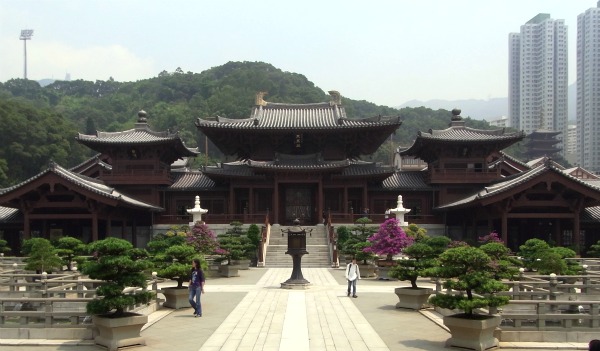
When Hamlet exhorted Ophelia to “get thee to a nunn’ry” he probably didn’t have in mind somewhere like Chi Lin Nunnery and the adjacent Nan Lian garden.

Nan Lian garden isn’t old. It was only opened back in 2006, but it harks back to the style of the Tang Dynasty (618-907 CE) with its trees, rocks, waterfalls and ponds

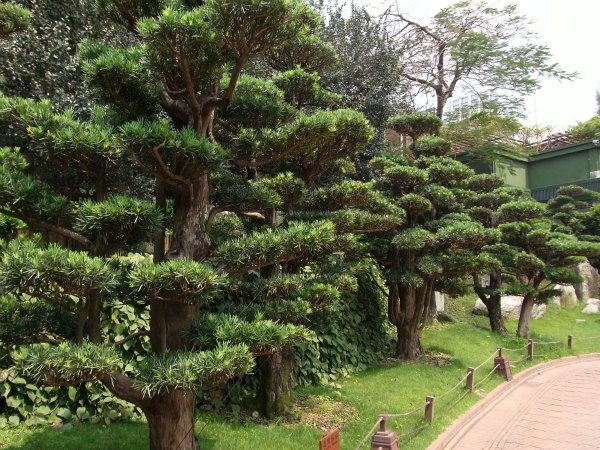
Conifers at Nan Lian garden

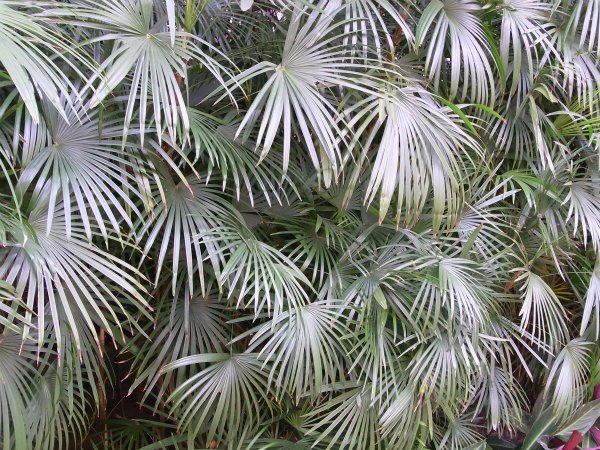
Palms at Nan Lian garden

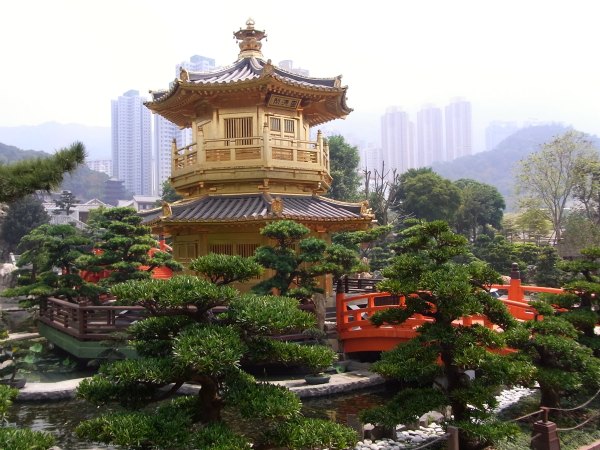
and wooden structures (all backed by incongruous skyscrapers).

Pagoda at Nan Lian garden

The nunnery also isn’t old. It dates from 1934, but was completely rebuilt in the 1990s using Tang Dynasty techniques; it’s made completely of wood without any nails.

Chi Lin Nunnery

Behind the impressive front courtyard are smaller enclosed courtyards which provide a soothing retreat from the bustle of Hong Kong city life. A wonderful place. I surmise for a spiritual retreat, and my favourite amongst the sites I visited here.

[HK&M 5]

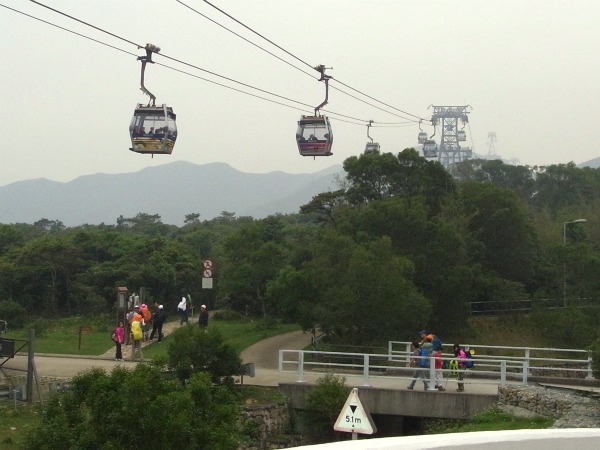
Lantau Island was originally home to a number of fishing villages. In recent years it’s changed, and it is now the home of the current Hong Kong airport and Disneyland, though I most certainly wasn’t there to make the acquaintance of Mickey & friends. No, I was there for Po Lin monastery and the Tian Tan Buddha figure. The easiest way to get there is by cable car, but just as the “Peak Tram” wasn’t a tram, this “cable car” wasn’t a cable car, but an aerial tramway. What is it with Hong Kong and misnaming transport types?

Nong Ping Cablecar

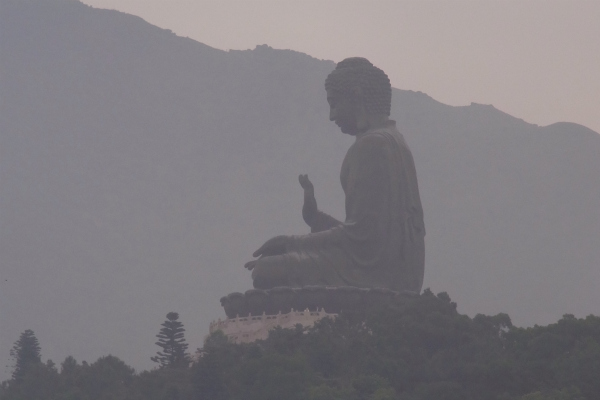
Anyway, after an almost 6 km journey I arrived in Ngong Ping “tourist village” with its souvenir shops, Starbucks, Subway and 7-eleven. One has to pass through this to reach the Tian Tan Buddha figure, which was the world’s tallest such figure prior to 2007. Made of bronze, it’s 34 metres tall and weighs 250 tonnes. It looked enigmatic in the drizzle.

Tian Tan Buddha figure

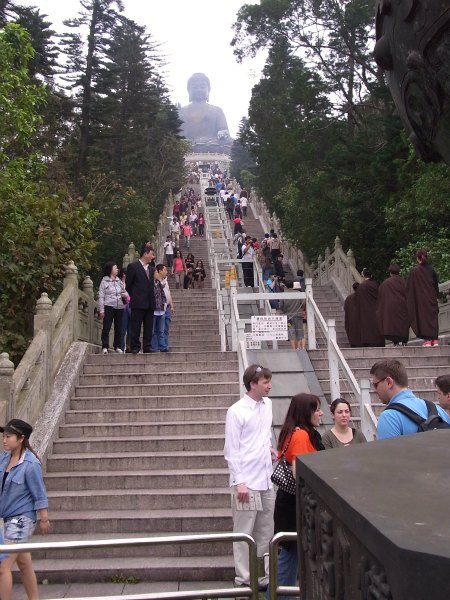
One can climb up a steep flight of stairs to reach it. (Pity, really, the cable car didn’t reach to the top.)

Stairs to Tian Tan Buddha figure

There were a monk and four acolytes making their way up the steps, chanting and prostrating themselves every two steps. You can see them in brown on the right in the photo. It was slow progress. By the time I’d been to the top and looked around, they were still only about a third of the way up.

Past the Buddha figure is Po Lin monastery. Nothing really of note for the tourist here. Just lots of burning incense and a large, modern gateway.

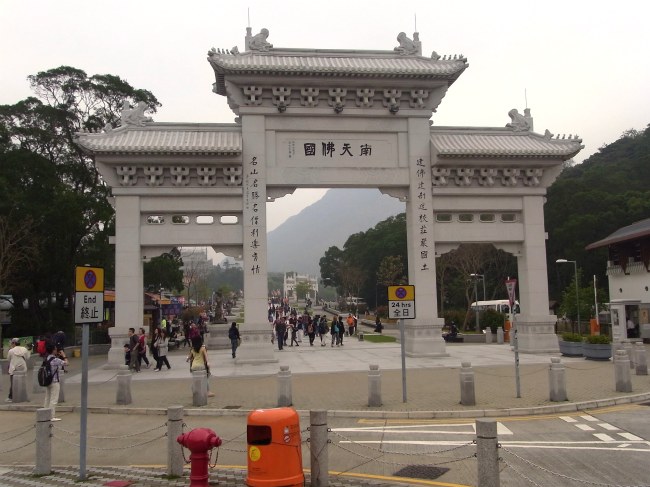
Gateway to Po Lin Monastery

***

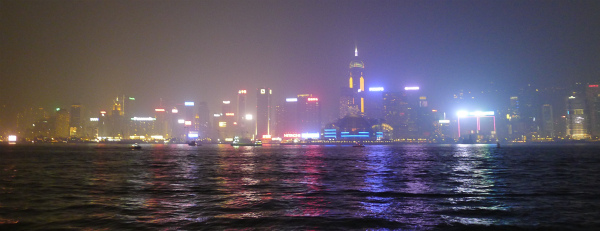
In the evening we took the Star Ferry to Kowloon. To be honest, the Hong Kong skyline doesn’t look that much different from the water than from Victoria Peak. However, when the sun set, the neon signs came to life.

Hong_Kong_at_Night

At 8 p.m. there’s what the Hong Kong tourist board calls “coloured lights, laser beams and searchlights [that] perform in an unforgettable all-round spectacle synchronised to music and narration that celebrates the energy, spirit and diversity of Hong Kong”. To be fair, some of that is true. It’s just the “unforgettable” and “spectacle” that are a little wide of the mark. I’m not really sure what is spectacular about office blocks turning their lights on and off. The first two minutes were interesting enough, and it made me wonder how it was achieved technically, but the “performance” long outstayed its novelty value.

[HK&M 4]

Hong Kong has a reputation as a paradise for foodies, and in the three days I was there I had three memorable meals, though not all for the right reason.

On the evening of the first full day I went to Kowloon’s Temple Street Night Market. The market itself is of little note. Just another crowded, closed off street lined with stalls selling tat of various descriptions. However, the area also houses a large number of restaurants, many with outside seating areas. I sat down outside one such restaurant and ordered a couple of firsts for me: stewed goose and mantis prawns. The large portion of goose breast arrived sliced, on a bed of peanuts and dressed with a little gravy accompanied by a tiny saucer of a vinegary dipping sauce. It was pleasant enough, though rather tough and not as rich and fatty as I’d been expecting. The mantis prawns were (I think) coated with salt and barbecued. They look a bit like miniature rock lobsters, with a flat, plated body. They apparently have a fearsome reputation for their aggression whilst alive. According to Wikipedia they “sport powerful claws that they use to attack and kill prey by spearing, stunning, or dismemberment” and are known in some circles as “thumb splitters”. In death they are simply incredibly well armoured, and it takes a lot of work to extract the tiny shred of (admittedly rather tasty) meat from within.

The following evening my companion spotted a restaurant he’d read about, Peking Garden. Apparently, there are few places in Hong Kong serving Peking duck, and this is reportedly one of the best. I rather doubted we’d get a table since it was the weekend, but we were in luck. Not having the capacity to demolish a whole duck (though personally really not lacking the willingness to try), we ordered stir-fried beef with scallions, chilli chicken and hot/sour soup – hardly the most adventurous of choices, but the food was excellent (as was the service). However, the almost endless procession of enormous, beautifully lacquered ducks being taken past, presented to the table, then carved in the restaurant was a might distraction, and my heart sank just a little with each passing bird. If only I were there as part of a larger group…

The final “memorable meal” was breakfast. It was at a café close to the hotel which was always packed whatever the time of day. As I write, the name of the place eludes me, much as I would like to name and shame. Perhaps the awfulness of the experience has blocked the name from my mind. Anyway, one ordered at the till on entering, then joined a line to pick up one’s food. I ordered an omelette with hash brown. Well, let’s just say that the “brown” part was a misnomer. It was a blob of semi-raw, watery, grey grated potato. And as for the omelette, to be positive, one side of it was cooked – albeit to a strange leatheriness. The other side was untouched by the effects of heat. Mercifully, it was very small.

Ah, Hong Kong! A gourmet’s paradise.

[HK&M 3]

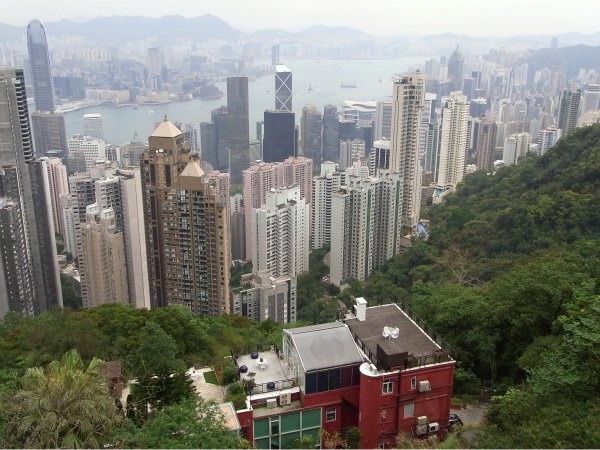
Apparently, one of the “must see” sights in Hong Kong is the view from Victoria Peak. When you’re in the heart of the city you can’t see quite how hideously god-awful the mass of concrete and steel imposed upon the landscape actually is since all you can see is the next monolithic temple to Mammon stretching to where the sky would be if you could actually see that far. Thankfully, a short ride takes you to a suitable vantage point to view the consequences of capitalist excess: Victoria Peak.

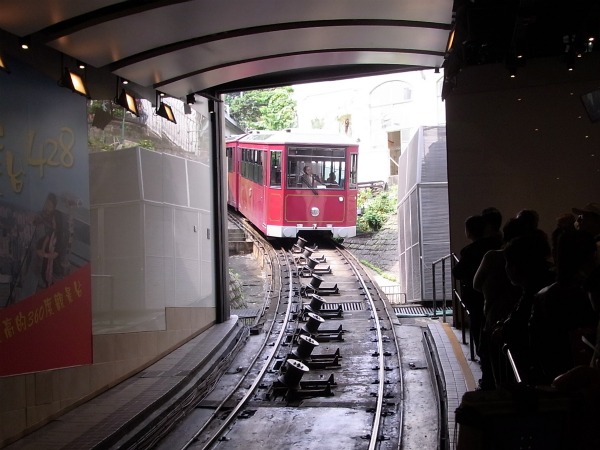
The journey starts with a lie: you take what they call the “Peak Tram”. It’s not. It’s a funicular railway, founded in 1888.

Victoria Peak Tram

Sadly, the tram has abandoned its original class system; in 1926 there were three classes:

First Class: British colonial officials and residents of Victoria Peak;
Second Class: British military and the Hong Kong Police Force personnel;
Third Class: Other people and animals.

The journey is steep, but mercifully brief at five minutes (unlike the queuing to get on). 1.4 km later and 400 metres higher one is dumped in a tacky gift shop (technically a “shopping and leisure complex”) curiously devoid of exit signs; anyone would think they wanted to keep you inside and spend all your money there. I eventually found an obscure backdoor exit next to the gents.

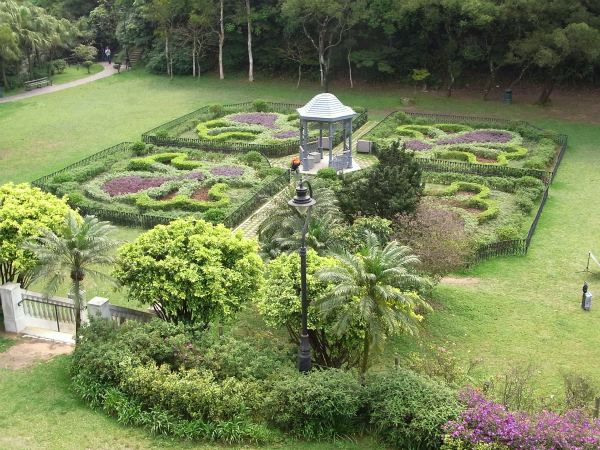
I’d read that there were attractive gardens which were originally attached to one of the residences of the Hong Kong Governors not far away. It’s a steep and sweaty climb, and as to whether it was worth it, I’ll let you be the judge.

Victoria Peak Garden

As for the concrete excrescence that covers the island, here’s one view:

Hong Kong Skyline

[HK&M 2]

Songkran, Thailand’s traditional New Year, is traditionally celebrated by getting drunk, getting into your pick-up truck or onto your motorcycle, then getting killed (or kill someone else). Admittedly, this year’s Songkran, earlier in the month, wasn’t a particularly good one. There were only 2,828 accidents, 321 dead and 3,040 injured over the 7 days of celebration. Fractionally more than last year, but far fewer deaths than on a really good year. Still, there’s always next year to look forward to – apart from for those who successfully ended their existences.

Songkran is such a fun time that the ruling Pheu Thai party decided a few days before it was much more entertaining to extend the parliamentary recess, rather than continuing its most important work of implementing widely opposed constitutional reform to grant its criminal fugitive leader a “get out of jail free” card so he can return to Thailand wisely governing the country. I rather suspect former PM Thaksin may be a little miffed at this.

Songkran is also marked by throwing bucket-loads of cold, dirty water over total strangers. Quite how a quaint tradition of pouring jasmine-scented water over the hands of one’s elderly relatives in blessing evolved into this carnage and mayhem is rather a mystery.

Anyway, faced with Songkran once more, I had to decide whether to stock up the freezer and lock myself in my house with a good book and a better bottle of whisky for a few days, or to travel to foreign parts. I took the road less travelled and headed off to Hong Kong and Macau.

I flew from Don Mueang airport, as it’s now spelled. (Before it was Don Muang, though neither spelling gets anywhere close to reflecting how it’s pronounced. Still, its spelling is rather a better shot than the totally impenetrable Suvarnabhumi.) This was the first time I’d flown from there since the floods of 2011 which inundated the place causing extensive damage. Even today only one of the three terminals has reopened, with a second scheduled to reopen in 2015. To be honest, there was little visible evidence of the flood damage, and the only bad flooding I encountered was in the gents toilet where, it appears, a significant number of men had been, shall we say, directionally challenged?

There were a lot of ethnic Chinese gentlemen waiting to board the flight to Hong Kong. It appears that they had also got into the Songkran spirit – “play Songkran” as Thai people say. As I entered the gents I was liberally sprinkled by a man shaking his hands as he exited. So much more fun to “play Songkran” than use the paper towels and hot air driers provided! Indeed, as I washed my hands post-pee, another Chinese gentleman decided to play Songkran all over my trousers as I stood at the sink. Such Chinese enthusiasm for a Thai tradition – even though Songkran wasn’t due to start until the next day!

***

I arrived at my hotel rather late, and immediately went searching for somewhere to eat. Most places were closed, including the Chinese restaurant I’d earmarked for a visit. Ended up having a Vietnamese meal, which wasn’t quite what I’d expected for a visit to one of the world’s culinary capitals.  The meal was decent enough, though.

Walking the streets I was somewhat surprised by the large number of Russians there. I was also surprised by the number of groups of men sitting on the street drinking alcohol. And despite racial stereotypes, these two groups didn’t overlap. My overwhelming impression, though was of the stench of dried seafood; my hotel was in a traditional dried seafood-selling area, selling every conceivable part (and quite a few inconceivable parts) of a fish dessicated. And in the morning light I would see streets full of shops selling these stinky delights, some simple places with boxes of what appeared to be foul-smelling cardboard stacked outside, and others with décor akin to a Swiss private bank, or a very upmarket jewellers with the finest specimens of olefactorily offensive fish offal displayed in glass cases.

And so my Hong Kong adventure began.


[HK&M 1]