Consider the magnificent King of the Jungle with his swinging mane stalking proudly through the savannah under the baking African sun. Now consider the same beast confined to a small cage under the heat of the halogen lights of a department store in central Bangkok. Something’s wrong here, surely. The distress of the beast is palpable – alongside that of a white tiger similarly incarcerated and that of the baby elephant made to spend the day walking in circles under the spotlights.

Even worse is the state of a Rusa deer – a notoriously sensitive species. Then there’s the barn owl whose deep, wide eyes are forced to endure the ceaseless flashes from visitors’ cameras.

And let’s not forget the meercat, lemurs, ostrich and bat-eared fox …

The department store – Emporium (let’s name and shame) – is one of the top stores in Thailand. The lesson they seem to preach is that it’s OK to do anything whatsoever to defenceless animals in the pursuit of profit.

Worse still is the involvement of various other organisation that one might have though would have the better interests of the animals at heart: the Zoological Park Organisation (ZPO), the Natural Resources and Environment Ministry, and the Chiang Mai Night Safari.

(Actually, the involvement of the Chiang Mai Night Safari doesn’t surprise me muchly. This night zoo was set up at the behest of former Prime Minister Thaksin in his home constituency purely to bring in more tourist dollars. Since its opening a little while back several hundred animals have died because of serious failings in their care.)

The chief of the ZPO is on record as saying “they will only be [at the shopping mall] for 10 days, not forever”.

So that’s OK then. Eleven days of torture bad, ten days of torture good.

[418]

Once upon a time, in a land far, far away, there were standards.

There’s a 1958 musical, Expresso Bongo, that includes a witty song with the lines:

“When I see this little bleeder
and compare him to Aida
… nausea.”

These are the words of a music promoter who, having fallen on hard times, decides to promote a rock & roll musician.

The song was banned by the BBC, and the subsequent movie of the same name (featuring the well-known English popular singer Clifford Richard) didn’t include the song; the word bleeder was deemed far too offensive.

Fast forward to today.

On the wireless one frequently hears a song by a so-called artist, Mika. Apparently aimed at prepubescent girls (who haven’t yet developed the nous to suspect the sexuality of a singer whose song video features him prancing around a teenage-style bedroom in a state of serious undress – no doubt much to the enjoyment of his gayer fans), his song “We Are Golden” features the line:

“Who gives a damn about the family you come from?”

I’m not concerned about his almost total nudity.  After all, nude wrestling was popular in classical times and is a perfectly proper pastime for an English gentleman.

I’m not concerned about his prancing. At least it was done in the privacy of his own bedroom. Poor lamb, he probably didn’t know there was a video recorder and operator in there with him the whole time.

I do, however, take exception to the filthy language. Damn is not a word to be bandied about in polite company. Heaven forfend some young, impressionable individual might hear such caddish language.

Standards are slipping.

Lord Reith, I trust and pray you’ll stop your gyrations soon.

[417]

In Thailand the favourite meat is probably fish, closely followed by chicken (though Thai Chinese people tend to favour pork); many a meal is accompanied by a Thai-style omelette (usually studded with minced pork and deep fried), and a fried egg (or “star egg” as it’s known here) is an essential topping for chopped meat stir fried with handfuls of chillies and basil. However, chicken aren’t only appreciated for their eggs and meat. A few months ago I visited the home of former Prime Minister Kukrit Pramoj. In the garden there were cages housing decorative chickens – more like bantams, really. Clearly there are people in Thailand who appreciate the prettiness of a nice cock.

Thailand Cockerel

Today, travelling to school on the subway, I noticed a man reading a magazine with photographs of beautiful cockerels seemingly in the peak of health. As he turned the pages more and more lovely birds were displayed. Clearly a cock-lover, thought I. Then I caught a headline: “School for Fighting Cockerels”. The beautiful birds featured may well have been ripped to shreds by now in some sordid and barbaric fight for the entertainment of some sick individuals. So sad.

Cock fighting is not against the law in Thailand, though the primary focus of the events isn’t so much the fight as the betting that surrounds it, which is illegal in Thailand (not, of course, that that stops its being widespread).

***

To find an image to accompany this Postcard I Googled Google Images for “Thailand Cock” – not an experience I’d recommend. Please burn out my eyes with a red hot poker now.

[415]

Going back a hundred years or so Hua Hin was a sleepy fishing village. Then, the then King, King Rama VI, decided to build a summer palace away from the heat of Bangkok. He chose a beautiful location overlooking the sea in spacious grounds

Sea view at Phra Ratchaniwet Maruekkhathaiyawan Palace

and named his new home Phra Ratchaniwet Maruekkhathaiyawan (พระราชนิเวศน์มฤคทายวัน).

Ground of Phra Ratchaniwet Maruekkhathaiyawan Palace

It was built in 1923 and the King first visited the following year.

The palace has three large wooden pavilions on stilts which run parallel to the sea front.

Wing of Phra Ratchaniwet Maruekkhathaiyawan Palace

Separate rooms are connected by walkway, with other walkways circuiting around the rooms to allow courtiers and others to move about without disturbing the occupants.

Red teak floors at Phra Ratchaniwet Maruekkhathaiyawan Palace

One pavilion was dedicated to the King’s consorts. It’s entrance was guarded by female guards who stood in these niches. The only man allowed to enter was the King himself.

Following the King’s death the palace was abandoned and fell into a state of ruin. It has since been lovingly restored (in the 1970s) to its former glory and is now a popular destination for domestic tourists and for school groups.

Girls being photographed at Phra Ratchaniwet Maruekkhathaiyawan Palace

Photograph of the interior wasn’t permitted, so there are no photographs from me of the King’s bathroom, with its imported Western porcelain, including a bidet, high flush toilet and enormous bath.

There’s little in the way of furniture in the palace; the King had his furniture transported from Bangkok whenever he visited.

A modest exhibition captured the costumes of the court’s women of the era – all very flapper.

Dress exhibition at Phra Ratchaniwet Maruekkhathaiyawan Palace

The King didn’t enjoy the palace for long. In fact, he only visited twice; he died in 1925.

[413]

Plern Waan (เพลินวาน) – the name means something like “enjoy yesterday” is – a recreation of an old-style Thai market, with stalls selling old-style goods such as traditional toys, sweets and ice lollies, postcards, nick-nacks and clothing.

Plern Waan Market, Hua Hin

There were also places serving “ancient” coffee, which is strong and sweet.

The individual stores and stalls are run independently, but the owner, Pattra Sahawat, vets them to make sure that they’re keeping to the spirt of the place; no Starbucks or McDonalds here.

Like any old-time Thai market, this place has its own radio station.

Plern Waan radio station

It’s all rather fake, with astroturf “grass”, concrete boxes fronted with pre-rusted metal panelling and strategically placed old signs.

Old signs at Plern Waan Market

It’s really the sort of place I feel I should hate. However, I enjoyed myself watching people enjoy themselves – most far too young to have remembered the old markets of this style.

And it seems that the Market is flourishing, because they’re in the process of doubling its size.

Plern Waan Market expansion

This place isn’t on the usual tourist trail. In fact, I didn’t see another pale face in there; though there were a few Japanese and Korean tourists, most of the visitors were Thai

Plern Waan Market

There’s virtually nothing on the Internet about this place in English, and it doesn’t, as far as I know, make it into any English-language guidebook. There is, however, a very modest website about the place in English:

http://www.plearnwan.com/en/home.html

[412]

In Bangkok, at Sanaam Luang, the large, open ground near the Royal Palace, about 300 people sleep rough every night. The Bangkok Metropolitan Administration (BMA) isn’t too happy about this. You might have thought that they’d be investigating how the problem of homelessness in Bangkok can best be resolved. They’re not.

In the district of Paak Khlong Talaat the traffic congestion is terrible. You might have thought that BMA might be investigating ways to relieve the choked streets. They’re not.

Now, Paak Khlong Talaat houses Bangkok’s largest flower market, so the BMA’s “solution” to both these problems is to turn Sanaam Luang into a flower market. With all the land covered by flower stalls the homeless will have to find somewhere else to sleep, and there’ll be less traffic in Paak Khlong Talaat.

There are a few problems with this apparent stroke of genius:

  • Sanaam Luang is used for ceremonies and other official functions several times a year, so would need to be completely cleared for these
  • The traffic around Sanaam Luang is already heavily congested. A flourishing flower market could only make it worse
  • How will the merchants at the existing market cope with the extra competition?
  • What will happen to the homeless?

It seems that the heady floral aroma has already affected someone’s senses.

[411]

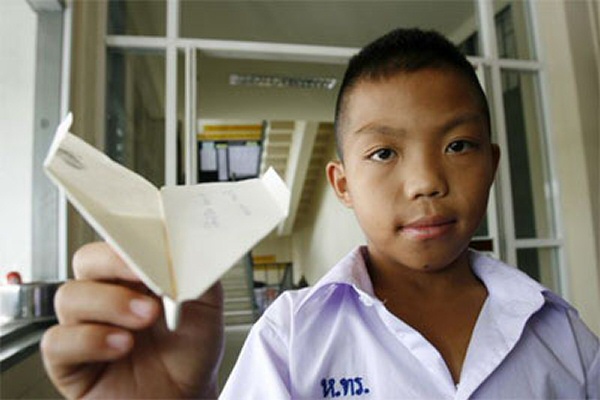
A young boy in Thailand is an absolute whiz at making paper aeroplanes. It’s his great passion in life. So good at it is he that he won the Thai national competition in 2008 and was invited to compete in the international Origami Airplane competition at Chiba, Japan.

You’d like to think that Thailand would celebrate its young people who excel. However, 12 year old Mong Thongdee (หม่อง ทองดี) was deemed a “threat to national security” by the Interior Ministry and was denied papers to travel. You see, Mong had the misfortune to be born in Thailand to migrant labourers from Myanmar and is considered a stateless person.

Mong Thongdee, a treat to national security
Mong Thongdee – a treat to national security

It took the personal intervention of the Prime Minister to persuade the Interior Ministry to change its stance, and Mong has now been granted a temporary passport so he can take part in the event. And, all being well, he’ll go. And I hope he does well for Thailand.

A boy of his skills could perhaps, in the future, be a great engineer or designer. However, Thailand will never benefit from his special talents. He’s on the list of stateless people to be repatriated to Myanmar on 28 February next year. There he and his family will face the tyrannical oppression of the junta faced by others of his ethnic group – a tyranny close approaching ethnic cleansing.

Sadly, this tale will have no happy ending.

[410]

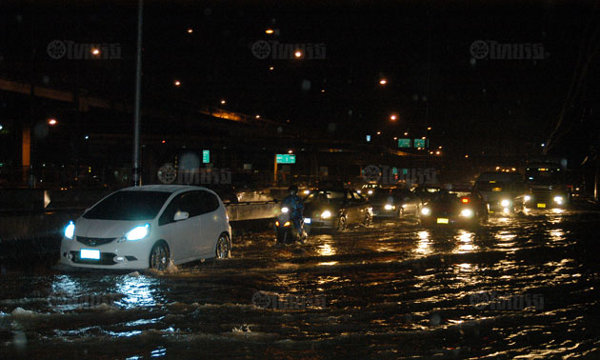
This morning I left early, around 6:30 a.m., to get to an hospital appointment. It’s not much fun taking nil by mouth from 8 p.m. the previous evening, so I like to let the vampire nurses drain my blood early in the day. Ten minutes later I found myself stationary. Two and a half hours later I’d not moved. There I was, hungry, thirsty and marooned in a sea of cars. What could possibly have caused this praeternatural chaos? It appears that the rain last night totally overwhelmed Bangkok’s drainage system; 44 areas of town were flooded. The one which was causing my own personal traffic hell was some 8 1/2 km away. I can only imagine the extent of the chaos behind me on the road.

According to Bangkok’s mayor, they can only handle 60 mm of rain, and last night more than 100 mm fell. This resulted in a major junction being flooded to the staggering depth of 10 cm. Quite why this should have totally immobilised traffic for several hours is a mystery. Why the police did so little (a.k.a. nothing) to redirect traffic is also a mystery.

Here’s a ‘photo from Thai Rath newspaper showing the offending flooded intersection:

Flooding in Lat Phrao

“And the waters prevailed exceedingly upon the earth; and all the high hills, that were under the whole heaven, were covered.”

Genesis 7:19 – King James Version (1611)

The weather forecast is for more rain tonight.

Now, where can I find myself some gopher wood?

[409]

Elephants are notionally banned from city streets – not that that stops them. (Perhaps they can’t read the signs.)

Unfortunately, the streets aren’t a safe place for a baby elephant, as the following picture shows:

Elephant in a Hole

He was eventually rescued unharmed.

[407]

Though having left the UK for good I can’t fully escape the clutches of the UK tax man. Unfortunately, the services provided to non-residents are shoddy (at best). However, they seem to have hit a new low.

Some time ago I sent them a message asking whether or not they had received a form from me. The response included the phrases:

“acceptable levels of customer service while dealing with your enquiries”

and

“We aim to provide a reply within 15 working days”.

Needless to say, they didn’t reply within 15 working days. And when I eventually got a reply, it read:

“Unfortunately, i will not be able to advise you if we have received your claim. We currently have a delay of 14 weeks in processing the R43 forms. Hence, it will not be possible for me to look for your claim. If you have not heard anything in say two and a half months please contact us again.”

(And yes, note the lack of a capital “I”.)

So, it’s take four to five months simply for Hector to say whether or not he has received a form. Goodness knows how long I’ll have to wait to receive the money he owes me.

Her Majesty’s Revenue and Customs? She should hang her head in shame.

[406]