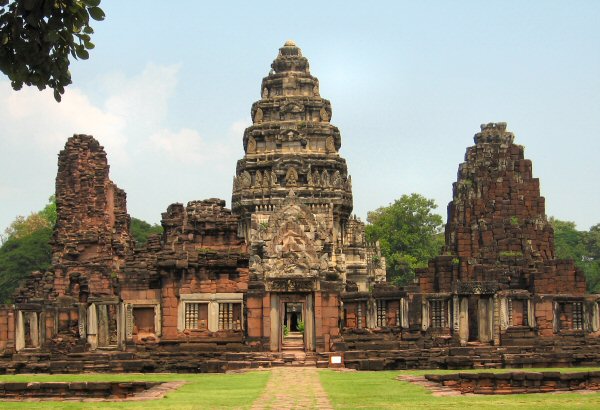
I broke the long drive from Khon Kaen (a large, bustling city with a terrible traffic problem) back to Ayutthaya with a stop at the town of Phimai, famous for its Khmer temple, Prasat Hin Phimai. Unlike the other Khmer temples I visited on this trip, this one is in the middle of town, surrounded on all sides by busy, shop-lined streets.

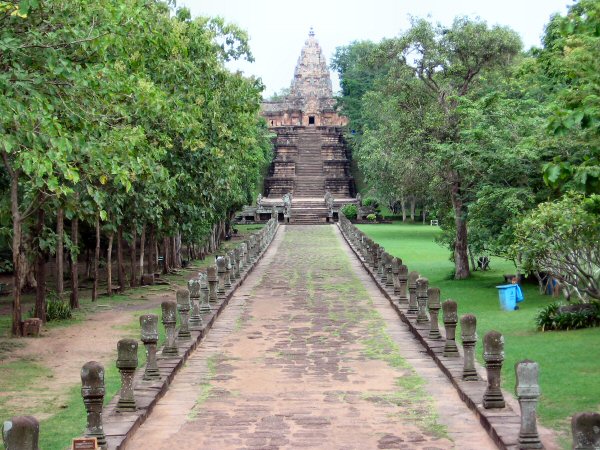
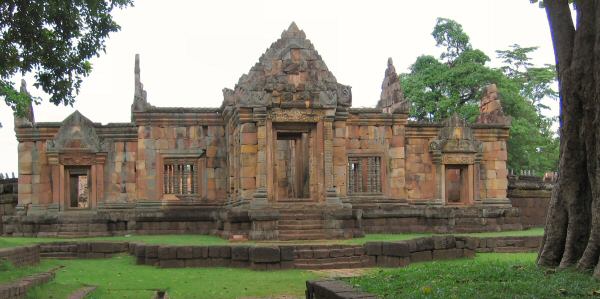
Prasat Hin Phimai

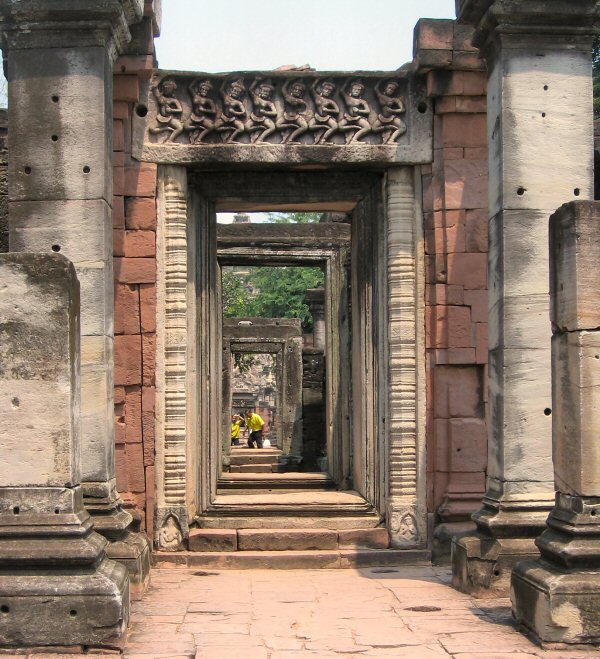
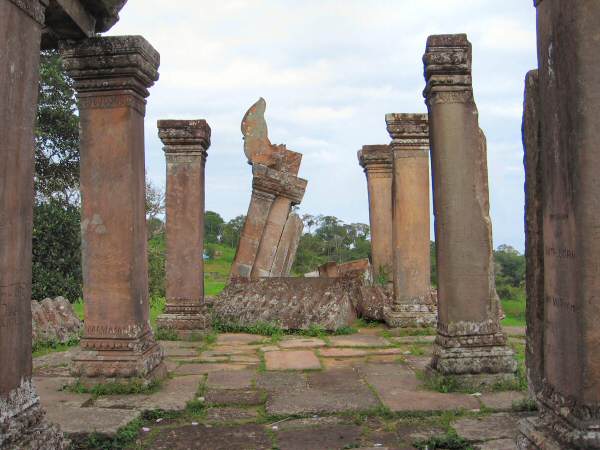
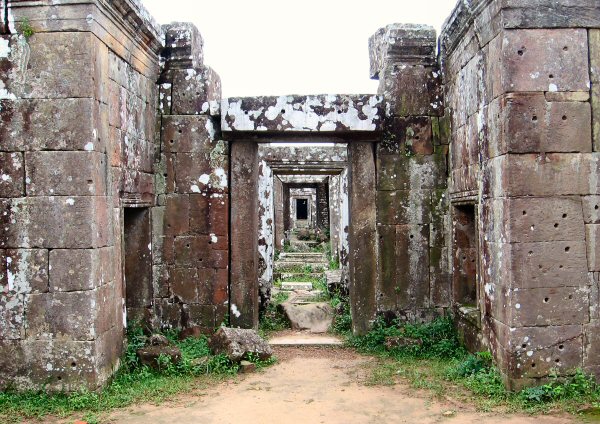
The format of the temple is very similar to the other Khmer temples I visited: an approach which passes over ponds and through smaller, cruciform buildings before entering the walled enclosure around the sanctuary building.

Phimai Sanctuary

This temple was also different because it had Mahayana Buddhist features, as well as the more usual Hindu ones.

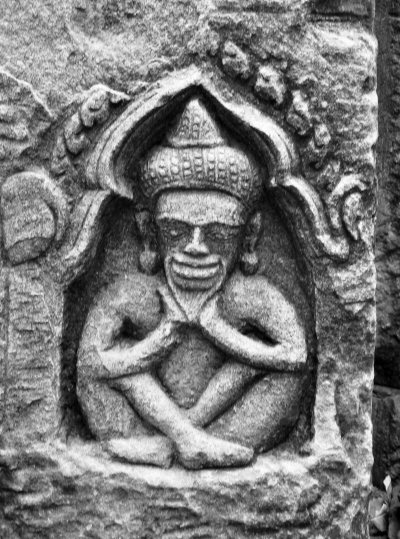
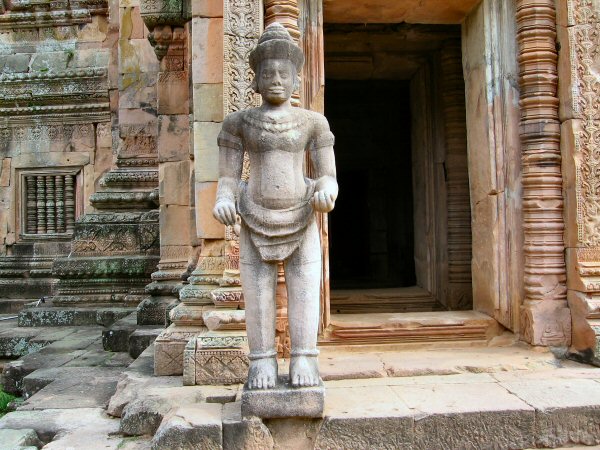
Figure at the base of a column

[292]

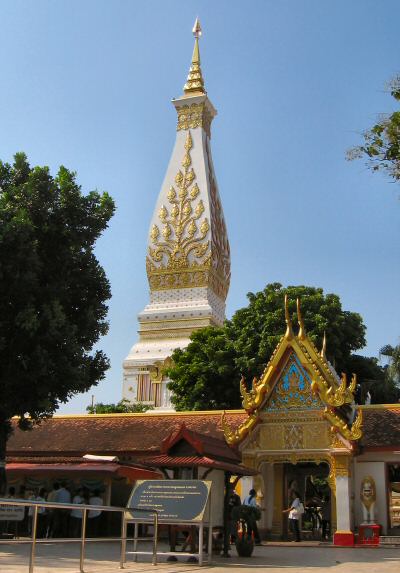
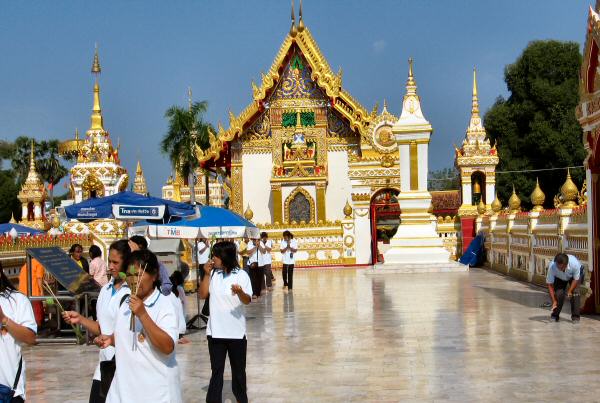
As one moves towards the Laos border the Lao influence becomes obvious, most notably in the temple design. And of all the Lao-style temples, Wat Phra That Phanom has the largest chedi – larger even than any in Laos.

Chedi Wat That Phanom

Here the colour scheme is red, white and gold.

As I arrived there was a procession of a few hundred worshippers who’d arrived in coaches. They passed three times around the chedi clutching burning incense sticks and lotus buds before kneeling and praying.

After visiting the temple, I went to the temple museum where I was approached by a novice monk, 20 years old. He’d been a novice for 8 years. I wondered what had happened in his life that he had left home at such a young age. Poverty is the usual answer, or an alcoholic parent, or parental abuse. Temples provide a useful refuge for desperate boys – but there’s nothing for the girls. This novice’s dream was to become a monk and to live in a famous Thai temple in London. He was therefore keen to practise his English. And the temple does provide English lessons to novices and to monks who wish to study.

[291]

Khao Phra Wiharn might be the most impressive Khmer monument in Thailand. It’s an Angkor period temple complex dramatically perched on the edge of a 600m high cliff on the rim of the Khorat plateau. It might be, but it is is not. Despite its being virtually inaccessible from the Cambodian interior, the World Court decided in 1963 that the land on which it stands is part of Cambodia. This is still a cause of resentment in Thailand, and a matter of sensitivity with the Cambodians. When, about 3 years ago, a popular Thai chanteuse suggested that it was really Thai, there was rioting in Cambodia.

Since the temple is only accessible from Thailand (Cambodian soldiers and officials have to walk 6-8 hours to reach the site) visitors have to pay two sets of admission charges: 400 Baht to the Thai government, and a further 200 Baht to the Cambodian authorities. (Thais, of course, pay 1/20th of this amount.)

Anyway, after an early start, I arrived at the Thai/Cambodian border at 7:30, only to find that the border doesn’t open until 8 a.m.. That gave me time to walk to the edge of a cliff facing Khao Phra Wiharn, from which good gives of the temple are to be had … provided it’s not misty. All I could see was a thick bank of fog.

Just before 8 a.m. I returned to the border crosspoint. On the far side I could see a group of people waiting to cross into Thailand – stallholders for the row of souvenir stalls lining the border car park for the most part.

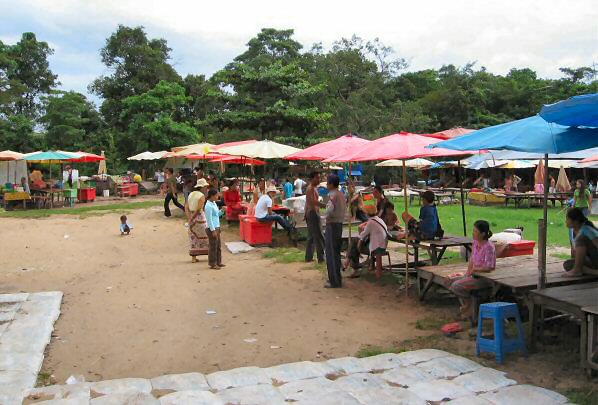
It’s about 1 km from the border to the start of the approach to the temple. First one passes through a small market selling cold drinks, bowls of noodles, souvenir trinkets and duty free cigarettes and alcohol. Young children play under the stalls, care free, oblivious to the grinding poverty. Slightly older children pester visitors (of whom there was only a handful) to buy postcards.

Village at foot of Khao Phra Wiharn

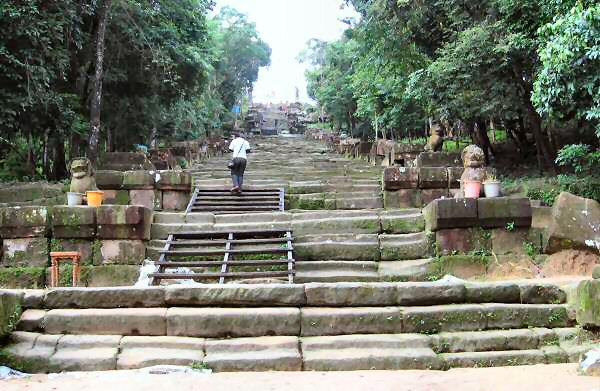
To get to the sanctuary one walks along a stepped, naga-lined path

Climbing up Khao Phra Wiharn

which rises 120m up the hill. (The complex is, in total, 850m long.)

The climb continues

One passes through four smaller buildings (gopura) in various states of disrepair along the way

Gopura at Khao Phra Wiharn

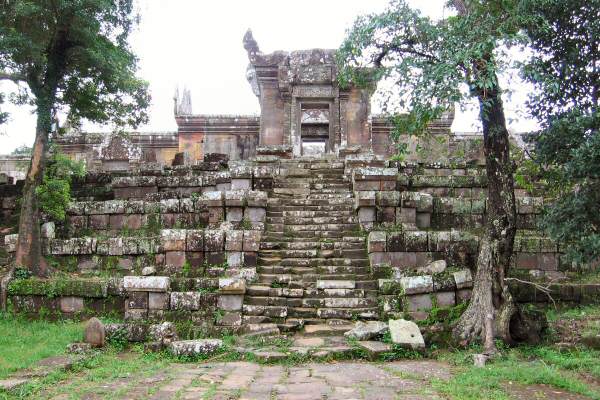
before reaching the central sanctuary, which sits in a walled compound and is surrounded by galleries.

Sanctuary at Khao Phra Wiharn

There are some nice carvings, but many are missing: stolen, lying in the piles of stone blocks which litter the site, or buried in the ground. And parts of the monument have been reduced by time to a chaotic jumble of fallen stones. But then, not a single Baht of either admission fee goes towards the restoration of the temple.

The tumbledown ruins might be romantic – a contrast to the immaculate, but slightly sterile, gardens surrounding yesterday’s temples – but the warnings of unexploded mines are less so. Whilst the complex is majestic, I’m left with a feeling of a tourist opportunity missed.

[290]

900,000 years ago the fire went out. The bright red faded to darkness, and the final puffs of smoke drifted into nothingness. The volcano that rose above the high, flat plateau was extinct.

A millennium ago the land around the volcano’s base was part of the Khmer empire; the people that built mighty Angkor were here, too. Their stonemasons carved blocks of stone to build temples, libraries, resting houses. They fashioned ornate lintels with elaborate scenes from Hindu Mythology: gods and demons in perpetual struggle.

When the masons had put down their tools, the worshippers came. They walked up the long promenade made from laterite blocks and lined with short columns topped with stylised lotus buds.

Approach to Phanom Rung

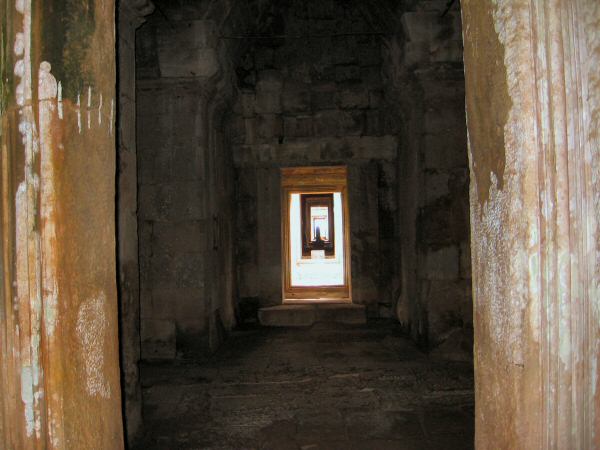
They passed ponds full of flowering water lilies. They walked over three bridges, each with naga balustrade, before passing the walls that delimited the temple compound and entering the gallery which leads to the inner sanctum. To get to the inner sanctum they passed stern, stone guardians…

Guardian at Phanom Rung

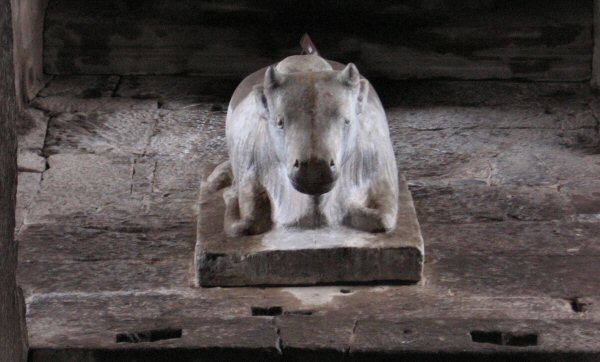
and a statue of Nandi, the bull chariot of Shiva.

Then, at the very heart of the temple, they saw the Shiva lingam and yoni (stylised male and female reproductive organs). Priests would pour offerings of oil and milk which would run over the stone phallus onto the receptive womanly parts.

Inner Sanctum at Phanom Rung

And today I stepped in the footsteps of these ancient worshippers.

***

Phanom Rung was built at the same time as the earliest temples around Angkor. The quality of the craftsmanship is equal to all but the very finest of work in Cambodia, and the scale of the temple is impressive. However, unlike the temples around Angkor, this temple was deserted – not a single other tourist on the entire site, just a few gardeners sweeping away a scattering of fallen leaves.

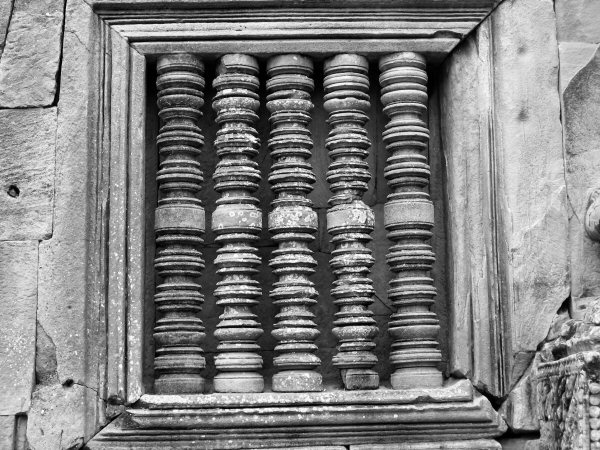
Blind Window at Phanom Rung

 ***

On the plain below Phanom Rung there is a number of smaller Khmer temples. I only visited one, Prasat Meuang Tam.

Prasat Meuang Tam

It dates from the 10th century C.E. And features a cluster of prasats, the largest of which is now a pile of rubble, inside a laterite boundary wall.

Ruined prasats

There are also formal L-shaped ponds around the corners of the temple. The bridges that crossed the moat outside the temple (now dry) are long gone, as is the Khmer empire that built them. The Siamese swept across the plateau and on even to Angkor itself, which they sacked in 1431 C.E., bringing back the statues, bronzes, architecture and dancing girls to enrich Thai culture. And the Khmer empire was no more.

[289]

Today I witnessed a re-enactment of the Ghostbusters film. Three men clutching metal canisters of poison arrived at my home and proceeded to pump their lethal gift into every nook and cranny,

I’ve been waiting for this for months, if not years. The first evidence of termite activity was a couple of years ago, with just a few traces in the bathroom. My landlord reckoned that a can of insecticide was the solution. They subsequently spread to the kitchen, bar area and my bedroom. About a month ago they launched a major assault on the bathroom ceiling, driving countless channels through it.

I’d got to a point where I was nervous about opening any cupboard, knowing there was a good chance that I’d be showered in termite sh*t. (They chew wood, then use the faeces to make tunnels through which they can travel without being exposed to light. These tunnels are often along the edges of doors.)

Eventually, about three months ago, my landlord agreed to get a professional exterminator to address the problem. However, nothing happened. It seems that the change of landlord has, at last, prompted action.

The exterminators started outside the house, drilling holes through the concrete border which surrounds the house and injecting poison. (Termites typically have large colonies underground, in sandy soil, and only invade houses during the rainy season – at least, that’s the theory.) More holes were made in pillars which support the house.

Then they came inside, spraying in cupboards, along skirting boards and into cracks in the parquet flooring. They drilled holes in the bathroom ceiling to inject more poison. Areas of the house I’d thought termite-free were revealed to have healthy infestations. The ghostbusters were, undoubtedly, very thorough.

They left after two and a half hours. I’m left with a house reeking of insecticide, with debris lining many of the cupboards, and the sound of agitated termites resounding from various colonies.

Still, it takes my mind of my other concerns.

[276]

My car means I have a new freedom, so I went to Rangsit last weekend to see the Simpsons movie. Most performances were in Thai, but there were three performances a day on the smallest of the 16 screens at the cineplex there. There was just a handful of people in the audience. I just hope the management don’t think that showing films in English is an unprofitable activity.

The movie itself was a bit of a disappointment; it lacked the complexity of the small screen cartoons – that is, not enough references to old movies and obscure cultural phenomena. Still, it passed the time.

I remember when I was a child film presentations in England would start with the National Anthem, and everyone would stand to attention. I’m not quite sure when that tradition was abandoned in the UK, but it still lives in Thailand. Actually, it’s not the National Anthem that is played, but a song about the King – and film of scenes from the King’s life, mostly showing him doing good works, is shown at the same time.

Last Sunday was the Queen’s birthday. This day also serves as Mother’s Day, so the restaurants were packed with families taking their mother out for a special meal. The temples were busy, too, with people making merit (i.e. bringing gifts for the monks) on behalf of their mother or grandmothers. However, that temple of commerce, Tesco-Lotus, was busiest of the lot. The enormous basement car park was full, and cars were parking on a piece of rough ground a little way from the store. Tesco-Lotus had a little shrine to her at the entrance, with her photograph in an elaborate gold frame, pots of flowers and lots of shiny blue cloth (blue being the colour of her birth day). People paid their respects as they entered.

Normally I avoid going to Tesco-Lotus on Bank Holiday weekends., but both fans in my sitting room had died. Still, upon seeing the seething throng, I decided it would be better to swelter at home than face the mêlée.

Fortunately, the weather isn’t too hot at the moment; it’s only getting up to 33 or 34ºC most days. Less fortunately, it’s also raining every day, albeit fairly briefly. The gardeners haven’t called for at least a couple of months, which means that the grass is getting rather long around the edges of the lawn. If it gets much worse I’m going to have to tackle it myself.

[274]

The Thai Baht used to be divided into 100 Satangs. One Satang is worth about 0.014 of a British penny – not a lot. In theory there are 1, 5 and 10 Satang coins, but I’ve never seen one. The smallest coin now encountered is worth 25
Satang. There’s a 50 Satang coin, too. Both are pretty well unusable. The vast majority of shops won’t accept them. Only Tesco-Lotus and a chain of department stores in Bangkok seem to use them. Anyway, the government has finally decided to phase them out; they were costing more to manufacture than their worth. Bizarrely, however, they have also announced that they are going to phase out the 1 Baht coin, too, leaving the 2 Baht coin the smallest. In
future, nothing can cost 1 or 3 Baht. (There’ll still be a 5 Baht coin, so 5, 7 and 9 Baht will be possible. However, I suspect shopkeepers will round every price up to the nearest even number, making things just that little bit more expensive.)

The 2 Baht coin rather elusive. I’ve only ever seen a handful of them. Of course, that could be because they are almost identical in size and colour to the 1 Baht coin. (The 1 Baht coin is 20 mm in diameter; the 2 Baht coin 21.75 mm.) More than once I’ve handed over a 2 Baht coin not realising it wasn’t a one. The government, realising the problem, has announced that it will change the colour of the 2 Baht coin from nickel to bronze. Quite how the problem wasn’t anticipated when the 2 Baht coin was first minted in 2005, I’m not sure. Still, better late than never.

There are images of these coins at http://en.wikipedia.org/wiki/Thai_baht

[273]

It was a Bank Holiday weekend here in Thailand, and now I’ve got my
car I can range far and wide. For my first long distance trip I’d
resolved to visit Khao Yai, Thailand’s first national park. It’s a
large area of pristine tropical jungle where wild elephants, gaur and
tigers freely roam. All commercial development is banned within the
park, so the local hotels cluster around the entrance.

Khao Yai lies about 2½ hours East of Ayutthaya (and a little North).
Though, if, as I did, you try to follow minor roads, it can take a
little longer; being stuck behind trucks trundling along at a
leisurely pace might have been frustrating, were it not for the
verdant green rice fields to either side. (And getting lost a couple
of times added even more to the journey.)

Ayutthaya is on Thailand’s central plain – hot and dry. Barely a
hillock disrupts the vast level expanse. So, as I drove East it was
somewhat strange to see limestone outcrops rising straight out of the
ground. Even stranger were the cement factories whose futuristic
pipework wouldn’t have looked out of place on the cover of some 1960s
science fiction novel, if accompanied by a similarly futuristic robot
or spaceman.

I checked in to a resort near the entrance to Khao Yai. There were
bungalows of various sizes and prices scattered over a large area, all
of them fairly basic.
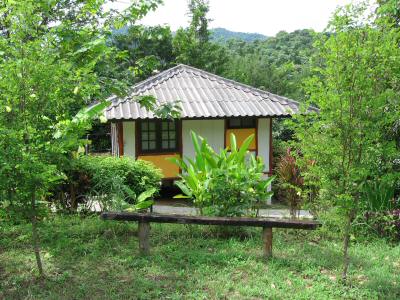
Cottage at Rabiang Dao Resort

I had a hot shower, fridge, aircon, firm bed,
and a TV showing a handful of grainy Thai TV channels – that was about
it. Even though the price was comparable with a 4* hotel in Bangkok,
there was neither fancy soap nor shampoo – not even a kettle for
making tea. The decor was somewhat eccentric, too.
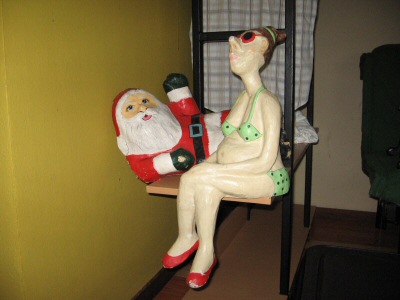
Inside the cottage - Santa and friend

After a long journey I didn’t feel like venturing out to find
somewhere to eat, so I tried the in-house restaurant. This was
probably a mistake. The food was pricy, and not particularly good.
But then, the local competition was from similarly pricy resorts.

Next day, the breakfast was no better.

A twenty-or-so minute drive took me to the entrance to the park. I
paid the 400 Baht farang entrance fee – plus an extra 50 Baht for the
car. (Thai people pay 40 Baht to enter.) There was then a long,
twisty drive rising up through the jungle. At first I passed through
deciduous forest in the drier valley areas, then evergreen forest at
higher, wetter levels. Being a Bank Holiday weekend, there was quite
a lot of traffic – but not enough to be irksome.

The enduring impression of is endless greenery, though there were a
few signs of mammalian life. I saw a furry sausage scuttle across the
road, an ape standing on the road, and a couple of deer. And I heard
the strange whoopings of gibbons (think of a chorus of demented swanny
whistles) and the background choruses of cicada and frogs. In the
south of the park there was evidence of the wild elephants (think
piles of brown, fibrous cannonballs on the road).

A highlight was a visit to one of the waterfalls, made famous by the
film “The Beach” in which Leonardo DiCaprio pretended to act. Of
course, this waterfall is nowhere near a beach – but that’s the
mystery of the magic lantern for you.
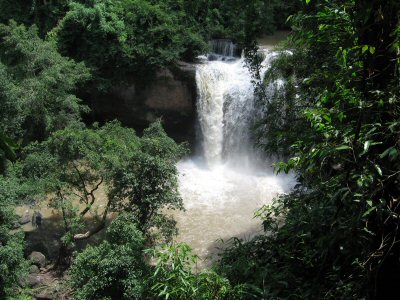
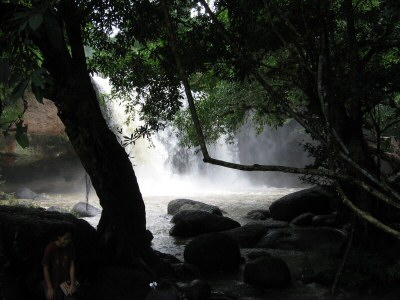
Heo Suwat waterfall from above Heo Suwat waterfall from below

Dinner was in a restaurant near the resort (I wasn’t repeating the
same mistake twice) – a place attached to a winery (the first in
Thailand, I believe). A perfectly delicious pizza (albeit with a
scattering of grapes on it), cooked in a wood oven, was accompanied by
a glass of Thai Shiraz and a fresh, green salad.

On returning to the resort, I found there was no water. After a day
in the jungle I was rather in need of a shower, but I had to retire
sticky. Still, I have major water supply problems in my house, so it
made me feel at home.

On rising, still no water. I headed for my rather grim breakfast
unshaven, smelly and grumpy. I was half planning on diving into the
pool with my bottle of shampoo and a bar of soap to render myself
clean.

Anyway, on my way back to my bungalow I had a nasty trip. My right
wrist broke my fall; and fortunately the fall didn’t break my right
wrist (though it took me a while to work out that it was simply a
sprain, rather than a fracture). I also badly grazed both my legs, so
I was horrified to find out that the water had been restored by the
time I returned to my bungalow. The sounds I made as I washed out the
wounds sounded like a dog that had been kicked hard. I’m sure my
yelping was audible across the valley.

The return trip to Ayutthaya was along faster roads (albeit with more
miles on the clock). And on the way I stopped at Chokchai Steak
House. Chokchai is a national institution; it was the place that
bought modern dairy farming to Thailand. Bottles of Chokchai milk are
on sale in every 7-11 and most supermarkets. And when I used to ask
my students to write about their favourite restaurant, a goodly
proportion would describe Chokchai. They (Chokchai, that is, not my
students) graze western-style cows (they look like Friesians) on the
rich grass around Khao Yai. The cows that don’t cut it on the
milk-bearing front (I believe they are called heifers) end up served
on hot iron plates with half a baked potato and a selection of veg.
Not that I had a tranche of cow – but the salad was jolly good.

[272]
My laptop has been in a sorry state for about a year now. The USB
ports died, which meant that I couldn’t use my cordless mouse or
attach my digital camera, and to print I had to route everything
through my ancient desktop PC. Anyway, yesterday I drove to Rangsit
(a small town on the outskirts of Bangkok, about an hour away) where
there’s an enormous shopping mall, Future Park.

On the way I stopped to fill the car up with petrol – but the first
garage had none. (Not that different from my last trip to Tesco-Lotus
where they had neither onions nor potatoes – but the shelves were
overflowing with carrots.) Still, there were plenty of other fuel
stops along the way.

At Future Park I parked in the multistorey car park – a nerve-wracking
experience for me. I definitely haven’t got the hang of reversing
into small spaces yet. I then visited half a dozen computer shops,
comparing their offerings. In the end I settled for a high end HP
computer with a 19″ widescreen monitor. It’s all very black and
shiny, and I love the cord-free mouse and keyboard. The price was
reasonable – a little over £400 – but then, of course, it didn’t come
preloaded with expensive software from Mr. Gates. In fact, it came
with FreeDOS, which might have been state of the art in the early
1980s, but doesn’t hack it now.

It seems to me that HP is conniving with software pirates in Asia.
In Europe and America their computers are sold with a proper operating
system preinstalled, so there’s no incentive to use a pirate operating
system. They know that in Thailand either the customer or (more
usually) the retailer will install a pirate copy of Windows.

Now, I didn’t want to install Windows – pirate or otherwise. This
wasn’t a fit of moral rectitude on my part; rather, I wanted to use a
modern, fast, secure and efficient (and free) operating system. In
short, I’d decided to install Linux – the Ubuntu distribution to be
specific.

After I got home I unpacked the boxes, cabled everything together,
stuck the Ubuntu CD into the CD drive and turned my PC on. In less
than 20 minutes everything was fully installed – not only the
operating system, but word processor, spreadsheet, database,
presentation manager and a selection of games. (This is a fraction of
the time it takes to install the Microsoft equivalents. See below.)

Once I started using the computer I was amazed to find how much of it
worked. Even the wireless mouse and keyboard worked perfectly.

There was only one snag: the modem was a WinModem. In other words,
the modem was designed to work only with Microsoft Windows (putting it
a little simplistically). I wasn’t worried. I knew that there was a
solution to the problem. In fact, searching on the Internet showed a
number of solutions – none of which was successful. After several
house of fiddling I reached the conclusion that I could either pay
$20/year to use some commercial software that would allow me to use
the modem, or I could download various software packages and recompile
the kernel. Now, $20 may sound cheap, but I could buy a new “proper”
modem for less than that. In fact, I have a suitable “proper” modem
in one of my other PCs that I could transfer. However, there’s a big
sticker on the back of my PC saying that opening the PC invalidates my
warranty.

After about 10 hours’ work I have given up. As I sit here I can see
Windows being installed on my beautiful new PC with heaviness in my
hear. What did that poor, innocent PC ever do to have such foul
software forced upon it? It’s already been and hour and a half, and
I’m still only half way through the installation.

(And when the installation is complete, the modem still won’t work –
but at least I know how to fix that relatively easily in Windows.)

[271]

In the market there is a group of almost identical stalls set out with
dozens of amulets. Customers peer at the amulets through an eyeglass
examining the details. These small clay plaques are believed to
protect their wearer from harm. They’re housed in small metal cases
with a transparent window and worn on a chain around the neck. Often
the chain is of such a thickness as to look more suited as a leash for
a large dog. Aficionados – and most are men – may have half a dozen
or more amulets, each on its own chain, ostentatiously swinging from
their neck.

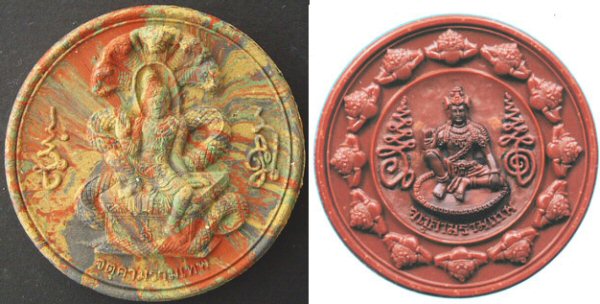
Recently the country has been swept by a craze for a particular amulet
by the name of Jatukam Ramathep. These amulets are round, about the
size of a digestive biscuit, and come in a number of different limited
editions with names such as “Arch-Millionaire”, “Super Rich” and “Rich
Without Reason”. The most expensive editions change hands for as much
as 2 million Baht (about £28,000). Their owners believe that their
Jatukam Ramathep amulet will bring them instant wealth, and as such
they are “better” than Buddha amulets, where the results are more
delayed.

Jatukam Ramathep amulets

These amulets were first made in 1987 at a temple in the south of
Thailand. The first edition was produced by a local policeman who was
believed to be a master of the occult. The amulets sold for 100 Baht
each. That edition now changes hands for about 500,000 Baht. Since
then more than 400 editions have been produced. One edition was
created by the temple’s monks whilst they were flying on a chartered
plane above the temple – precisely why, I’m not sure. A top of the
range new edition, covered in gold leaf and from a respected temple
will now cost you 10,000 Baht – more than a month’s pay for many
Thais.

Of course, these amulets are contrary to Buddhist teaching, but the
Religious Affairs Department and the Sangha Supreme Council keep
schtum. After all, they’re a nice little earner. Want a new temple
building? Just make some amulets, pray over them for a few days, and
sell them off. One revered monk, Phra Payom Kalayano, did make a
protest by baking chocolate cookies in the shape of the amulet,
proclaiming, tongue in cheek, that four bites would make you supremely
wealthy. His cookies are selling like … hot cakes. His intention
was to encourage people to spend their money on essentials, such as
food, not on pointless trinkets. As he said “recently, materialism
and the amulets have diverted people from the core of Buddha’s
teaching. This makes Buddha’s teaching fade away.”

But what of the name “Jatukam Ramathep”? This isn’t something from
Buddhist or Hindu teaching. One theory is that it’s a conflation of
the names of two princes from about 300 CE who guarded a sacred Buddha
relic whilst their father went to Sri Lanka. Others say it’s the Thai
pronunciation of the Pali Catugamaramadeva (God Rama of the Four
Villages). A third view is that the name refers to the legend of King
Janthara Bhanu, the founder of the Srivijaya empire who became a
Bodhisattva. But equally possible is that the name was conjured out
of thin air.

[270]