There’s been a lot of grumbling from our American cousins on various
web bulletin boards about the falling value of the dollar. Retirees
here have been particularly hard hit; they are required to have
800,000 Baht in their bank account each year three months before they
renew their retirement visa.

Personally, I haven’t been particularly bothered by the dollar’s fall.
Less than 10% of my investments are in the US (I saw the writing on
the wall several years ago), and the values of the pound and euro
aren’t that far from where they were three years ago.

I was, however, taken aback when I booked my hotel room in Bangkok for
this weekend. The cost has gone up from about £35/night three years
ago to closer to £50. It took me a moment to realise that this was
because hotel room prices are based upon a US Dollar figure. I then
decided to dig up some data on the USD/THB exchange rate over the last
couple of years.
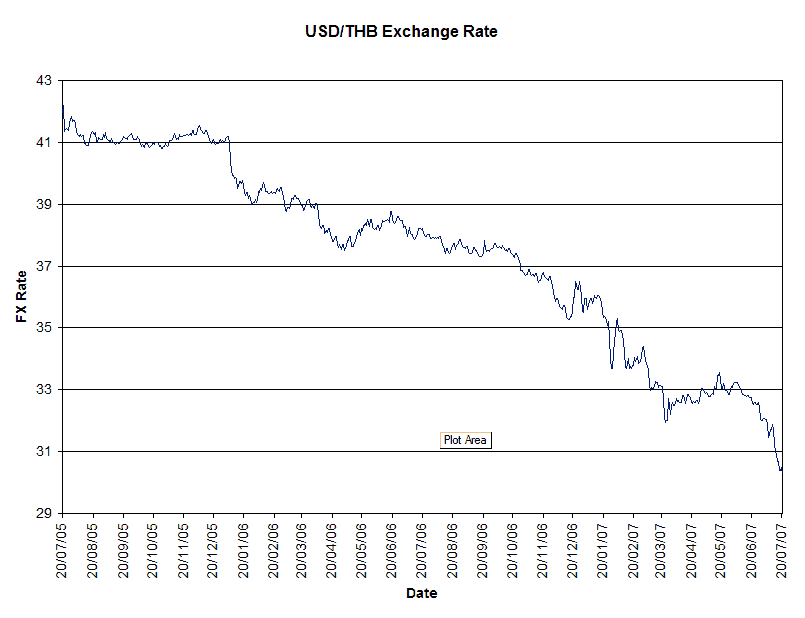
USD/THB Exchange Rate
[Click for larger image]

In short, whereas two years ago one dollar would buy you 42 Baht,
now you get less than 30 – a 29% fall in value.

Putting it another way, the American retiree who two
years ago had to transfer $19,000 to stay in Thailand now has to
transfer $27,000 – a staggering increase. I can now see why some
retirees are saying that they don’t have enough money to continue
living here and will have to leave the country, abandoning their wives
and children.

This isn’t all because the Baht is particularly strong, though it has
been supported, as have almost all currencies in the SE Asian area, by
proximity to China. And a large inflow of speculative money has
forced the value of the Baht up (though the government has taken
fairly draconian steps to halt this inflow). The root problem is that
the value of the Dollar has fallen against pretty well any currency
you care to mention.

America is bankrupt, and has been for some time. It owes far more to
other countries than it can possibly hope to repay. Its currency has,
in the past, been propped up by what are effectively loans from other
countries – massive loans. Now, these other countries (most notably
China) are dramatically cutting back their US Dollar reserves. This
in turn drives the value of the dollar down further, making it look
less and less suitable as a reserve currency. And so the spiral
downwards begins. At the same time you have the rise of the Euro as a
credible alternative reserve currency. (Oil and other international
deals are increasingly being done in Euros rather than Dollars.)

I feel rather like Cassandra, but I can’t help but think that we’re
seeing the beginning of the end of the American empire.

Well, I’ve done something I never thought I would do:  I’ve bought a
new car.  I always thought it was folly to buy something that lost a
third of its value the moment it went on the road.  Still, a little
foolishness can be fun.

I wasn’t expecting the car to arrive at the showroom until next week,
but I got a ‘phone call yesterday morning, asking me to come in the
next day at 9 o’clock with a cashier’s cheque for the balance.

And today, at 9:39 I drove my new Toyota Vios away.

My friend who drove me to the showroom insisted that I leave at a time
ending in the number nine, this being seen as auspicious.

I drove to a nearby garage to get some petrol, then headed home
cautiously.  I’m finding it a little difficult to get out of some of
my motorcycle habits.  For example, I’m turning my head fully around
to look before every manoeuvre, rather than relying on the mirrors.
Funnily enough, I didn’t have this problem on the occasions when I
drove a hire car.

I’m also going to need to be a little careful about the width of the
vehicle.  All those weeks ago when I took a test drive I headed for
the narrow motorcycle lane going into Tesco-Lotus, rather than the car
lane.

I haven’t really explored all the car’s features yet, but this is the
first car I’ve had with air con and central locking and a CD player.
I guess cars have moved on in the twenty years since my last car was
built.

Well, I’m off to Tesco-Lotus now to buy a few of the big things that
I’ve not been able to carry home on my motorcycle.  Jumbo packets of
loo rolls here I come!

[268]

Since watching parts of the Live Earth concert last week I’ve been
more aware of my more profligate uses of energy.  I’ve been more
conscientious about switching off fans and lights when leaving a room
– though the large number of failed light bulbs in the house is more a
consequence of my apathy than of my green warrior credentials.  (My
sitting room alone has 27 light bulbs, so a few dead ones doesn’t
leave me sitting in gloom.)  However, I’m left with a serious
environmental question …

A friend of mine, G., from Bangkok wanted to make merit for his late
father.  That is, he wanted to give goods and a little money to a
local temple.  Some people put together their own collection of items,
but most people buy a ready made present in the form of an orange,
plastic bucket full of things useful to monks.

I picked up G. on the back of my motorbike and went looking for a shop
selling such buckets.  I knew that Tesco-Lotus had a whole aisle
devoted to such gifts, but that seemed a long way to go.  I rode
around town until G. spotted a small textile shop.  Outside was an
woman selling lottery tickets – and there were three orange buckets in
different sizes (and at different costs).

My friend bought a bucket containing toothpaste and brush, a tin of
pilchards, some candles and incense sticks, a bar of soap, and other
essentials of monastic life – all wrapped in cellophane.

We went to a local temple, Wat Maheyong.  It was my choice; I respect
it because it attracts a large number of laity because of the quality
of its meditation teaching.  I felt a bit bad, because my friend
wanted to donate to a smaller temple, and the place was much larger
and busier than I had remembered.  Still, he was gracious and said it
was the gift that mattered, not where it was given.

The temple is a pleasant place, with groves of trees and tranquil
ponds.  Today there were many 8-precept followers dressed in white
robes wandering about, and a handful of monks in saffron.

I held back as G. approached a monk sitting inside an artificial cave.
The monk spent a few moments adjusting his saffron robe, with much
rolling of fabric and tucking of ends.  It was a much more elaborate
process than I’d assumed.  The monk ready, G. then handed over his
basket and put the envelope on a nearby tray.  The monk then chanted
something in Sanskrit or Pali (I wasn’t close enough to hear clearly).
Then there was a brief conversation – mostly G. asking what kind of
gifts were most appreciated.  Apparently there are to many candles –
these are very traditional, but now that the temples are lit by
electricity a cash donation to pay the electric bill would be more
helpful.  And for this temple, there was a particular problem
associated with the large number of lay residents:  whilst monks make
daily alms rounds, the guests don’t, and the monks don’t collect
enough food for the whole community.  Donations of basic foodstuffs
were therefore particularly appreciated.

But the environmental question I’m left with is:  what do they do with
all those orange buckets?

[267]

It was shortly before 4 o’clock.  I was sitting in my favourite bar
sipping an iced latte.  I had an appointment on the other side of
town.  I’d booked a massage.  It’s not something I do very often.  To
be honest, the memory of the pain lingers longer than that of the
pleasure.  Still, there’s a nice, clean place on the edge of the river
where one can be massaged in a sala (open-sided pavilion) that came
highly recommended.  The weather looked ominous.  I was therefore
looking forward to being pummelled whilst torrential rain fell outside
the sala.  There’s something about a heavy downpour that clears the
air and enlivens the spirit.  So, I set off for my treat.

I’d gone two blocks when I hit a police road block.  It was the usual
“get off your motorbike, take off your helmet and look respectful”
thing.  The route had been lined with yellow flags, so I knew it was
the Crown Prince visiting.  (Each member of the senior royal family is
associated with the colour of their birth day – the King and the Crown
Prince were both born on a Monday, so their colour is yellow.)  We
were all kept waiting for a little over quarter of an hour before the
royal convoy arrived.  There were 16 police cars, an ambulance, a
large coach full of gentlemen in uniform, and a number of cars.

When the road block was finally lifted along the length of one of the
major roads which cuts the island in half, 15 minutes’ worth of backed
up traffic surged forward at once.  It was chaotic.  I was trying to
go as fast as feasible, but I was going to be rather late for my
massage.  I was feeling stressed – not the best preparation for
relaxation.

There was no problem with my appointment, but it was moved indoors to
a small, air-conditioned room in a wooden house on account of the
weather.

I was given a well-washed cotton T-shirt and a pair of faux-silk
pantaloons to put on.  It took every atom of self-control that I
possessed not to do my MC Hammer impression (You can’t touch this).

Anyway, the massage started with the masseuse holding a cold, damp
cloth over my face, then gently pressing in various places.  Then the
serious stuff started:  she moved onto my feet.  Here she pressed what
are euphemistically called “pressure points” – “pain points” or, in
some cases, “agony points” would be more accurate.  Then there was the
kneading, and contorting my body into unnatural positions and then
applying further pressure so as to cause maximum discomfort.

Perhaps the most unpleasant part of a traditional Thai massage (at
least for me), is having the masseuse tug on my toes, one by one, to
crack the joints.

Maybe the principle of Thai massage is that it’s like banging one’s
head against a brick wall:  it’s nice when it stops.

And when it stopped I received a hot cup of sweet, strong ginger tea.
Just what was needed to heat the body after the air-con got a little
chilly.

The two hours passed quickly, and I’ll be sure to go back again soon.

[266]

Yesterday was D.’s third birthday, and a small party was held in
her honour. Friends of the family and the neighbours came around
bearing gifts to mark her special day. There was a small cake with
candles, soft drinks and nibbles for the children and beer for the
adults. B. had also made a pot of spaghetti sauce to ladle over
plates of pasta.

So, we sat around for a couple of hours on the house’s small veranda
whilst D. unwrapped her presents – almost all of which seemed to
be made of pink plastic and made in China. On a telegraph pole
opposite the house squatted a white owl, calling into the night.

The party started at 9 p.m., when her father got home from work. To
make ends meet he has two jobs. He teaches English in a state school
about 30 km away. He rides there every morning on his motorbike to
start work at 8 a.m., and finishes work at 4:30 p.m.. He then just
has enough time quickly to shower and change clothes before he starts
his second teaching job from 6 p.m. to 8:30 p.m.. That’s Monday to
Friday. At the weekend he works a further 12 hours. That’s a 67 hour
working week, working 7 days a week, just to be able to support his
family.

It’s not that farang English teachers are paid badly here – they’re
paid about double what their Thai counterparts earn. It’s just that
there are some things it’s difficult to live without, such as the
occasional western-style meal, English DVDs and English language
television. The costs mount quickly. Plus the average farang wants
to have a car, rather then take the family on public transport. And
then there’s the farang surcharge upon almost everything you buy: one
price for the Thais, and one for people with long noses. You can buy
food fresher and cheaper in the market than in Tesco-Lotus, but only
if you’re Thai.

English teachers in other parts of Asia – particularly Vietnam, China
and Japan – are paid vastly more than those working in Thailand. The
real problem is that the Thai government isn’t committed to good
quality education (in any field), and there’s an endless supply of
unqualified backpackers, sex tourists, drug fiends and alcoholics who
will work for very little just to be able to stay here longer term,
and this keeps pay for even well qualified English teachers low.

Of course, if the government rigorously enforced the law requiring all
teachers to have a university degree and a teaching qualification,
standards and pay would go up, but there would be too few teachers
left.

One recent trend, though, has been increasing numbers of Philippine
teachers. English isn’t their native language, but many of them speak
it reasonably well (and infinitely better than the vast majority of
Thai teachers of English). And why this trend? It’s because they’re
cheap – willing to undercut all but the most desperate backpacker.

There’s nothing like a good quality education. And in Thailand, what
the vast majority of students gets is nothing like a good quality
education.

[265]